Why exercise needs to change in perimenopause — and most women are doing the wrong kind
The research is clear: the exercise that served you in your 30s may be working against you now
Many women arrive in their mid-40s doing exactly what they've always done - walking, running, group fitness classes - working hard at it, and finding that their body is no longer responding the way it used to. Weight is shifting to the middle. Recovery is slower. Sleep is worse after a hard session. If this is your experience, you are not doing something wrong. You are doing the wrong thing for this stage of life.
The hormonal changes of perimenopause fundamentally alter how the body responds to exercise. Understanding this is not an excuse to do less but rather it is an invitation to do differently. And the difference, supported by a growing body of research, is significant.
The myth of more cardio
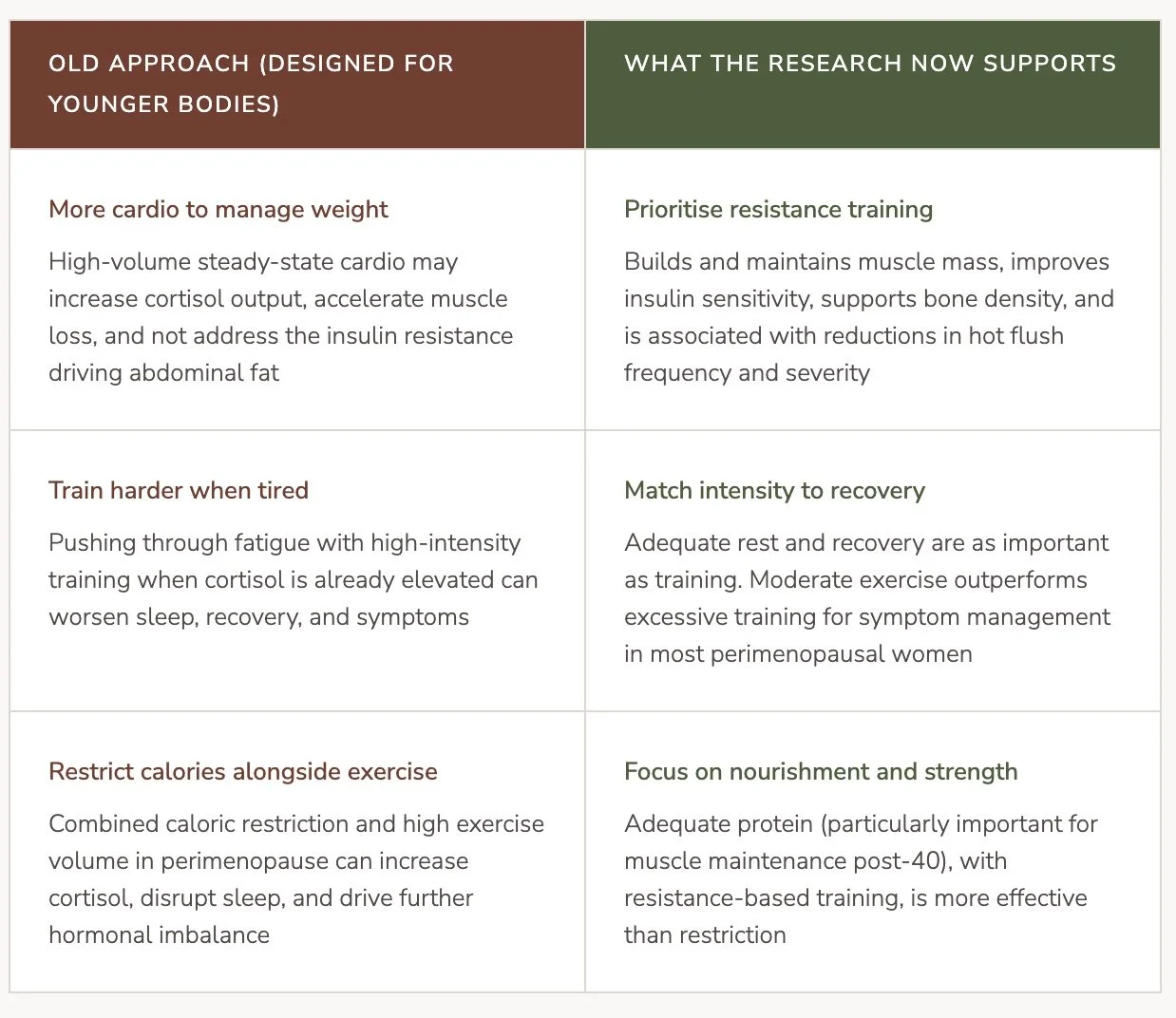
Many women who notice perimenopausal weight gain particularly around the middle, instinctively reach for more cardio. Longer walks, more running, additional classes. This is understandable, but for many women in perimenopause it is counterproductive.
Here is why. Declining oestrogen promotes insulin resistance and shifts the body toward storing fat viscerally around the abdomen regardless of calorie intake or exercise output. At the same time, muscle mass begins declining at roughly 1% per year from the late 30s. Less muscle means a lower metabolic rate at rest. High-volume cardio, particularly when performed in a state of elevated cortisol (which is common in chronically stressed perimenopausal women), can actually accelerate muscle loss and drive further cortisol output, worsening the very hormonal picture driving the weight gain.
What the research actually supports
Resistance and strength training — the priority
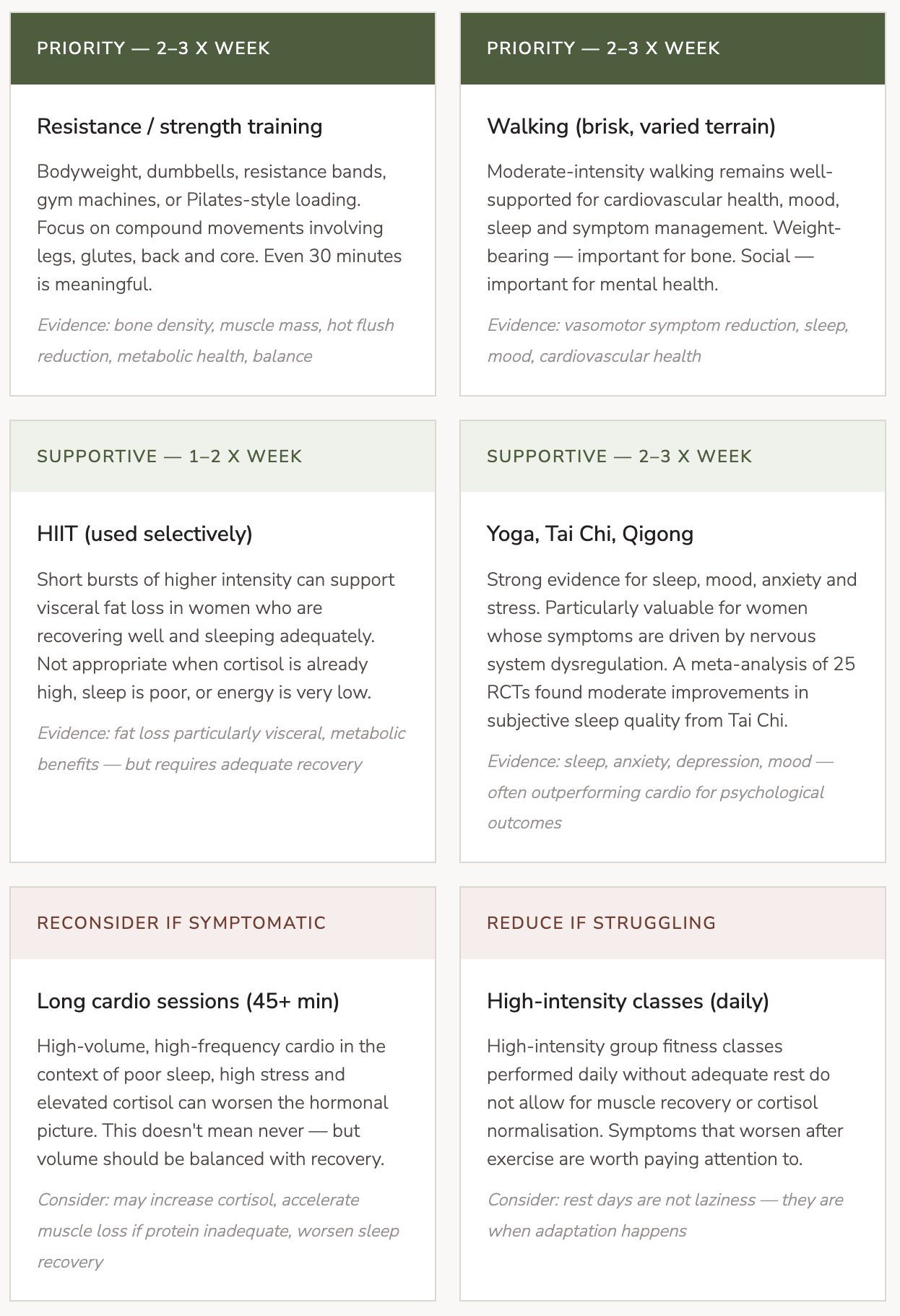
A 2023 systematic review of 12 randomised controlled trials published in the Journal of Clinical Medicine found that resistance training was associated with significant improvements in muscle mass, bone density, metabolic and hormonal changes, and hot flushes in menopausal women outperforming inactive control groups and, in some outcomes, other exercise types. A 2025 study from the University of Exeter, the first of its kind, found that low-impact resistance training improved hip strength, balance and lean body mass in women aged 40–60 across pre-, peri- and post-menopausal groups equally, suggesting that the menopausal transition does not impair the ability to benefit from resistance exercise.
“Strength training not only helps increase muscle and bone mass, it helps with other common issues of menopause including cardiovascular disease, insulin resistance, and impairments to mood, cognitive function and sexual health.”
A suggested weekly framework
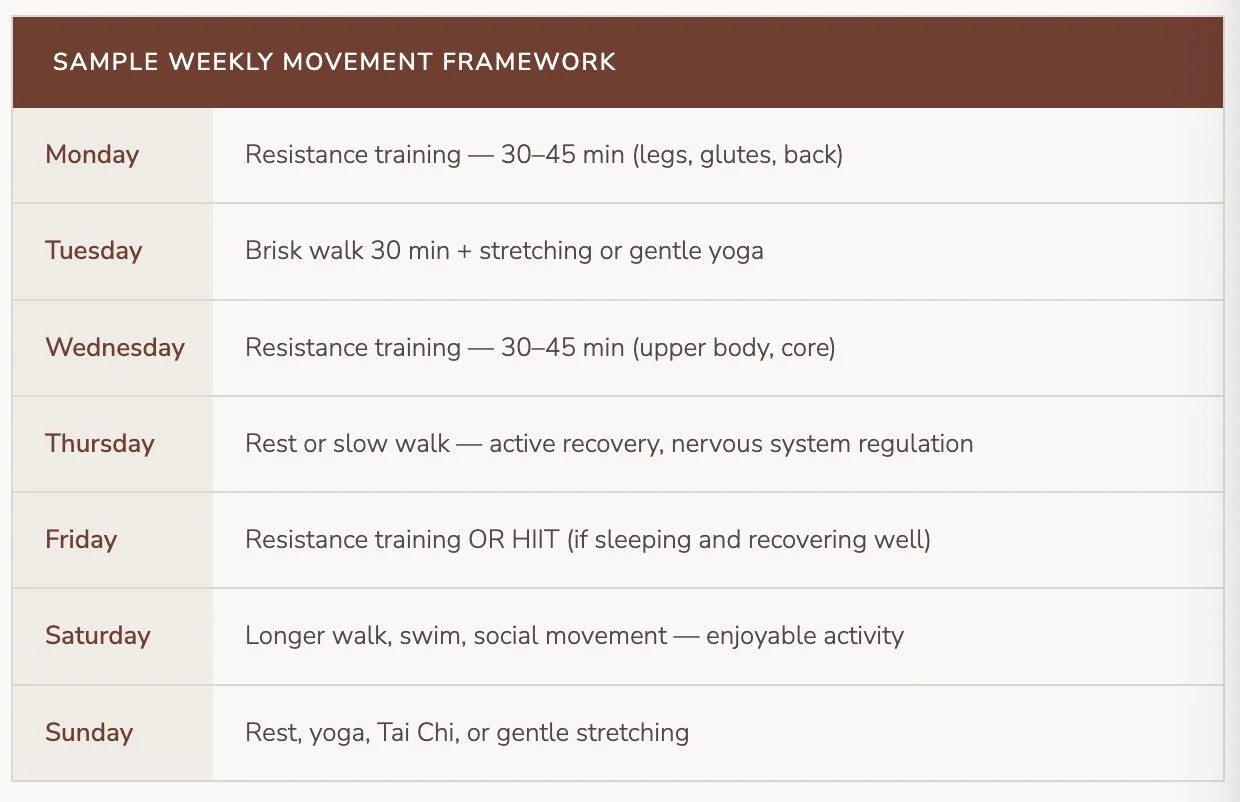
This is a general starting framework only, not a prescription. It is designed to illustrate balance between resistance training, movement, and recovery rather than maximum volume.
What Chinese medicine adds to the movement picture
Exercise from a TCM perspective
Chinese medicine does not recommend the same exercise approach for everyone. The type and intensity of movement that supports your health depends on your underlying pattern. A woman with significant Kidney Yin deficiency who is already running hot, exhausted, and depleted needs fundamentally different movement guidance from a woman with Liver Qi stagnation and sluggish circulation who needs to move more.
In Chinese medicine, sweating to exhaustion is generally not considered healthy, particularly in midlife. It depletes the Yin and Jing (vital essence) that the menopausal transition is already taxing. Exercise that builds rather than depletes like strength training, moderate walking, Tai Chi, and Qigong aligns more naturally with supporting the Kidney system that underpins this life stage.
If you are exercising regularly but your symptoms are worsening, your sleep is deteriorating after sessions, or you feel more depleted rather than better, that is important clinical information. A Chinese medicine assessment can help identify whether your current approach is supporting or undermining your pattern.
The take-home message is simple: perimenopause is not a reason to exercise less, it is a reason to exercise smarter. Shifting the emphasis from volume to type, and from exhaustion to recovery, often produces better results for body composition, symptoms, sleep, and energy than doing more of what has stopped working.
Want to understand how your exercise approach fits your pattern?
A Chinese medicine assessment considers your energy, sleep, recovery, symptom picture and lifestyle together so that any advice is genuinely tailored rather than generic.