MHT and Chinese medicine: can you do both?
One of the most common questions I hear from women in my clinic is this: "I've started MHT. Do I still need acupuncture?" The short answer is yes, and understanding why requires looking at what MHT does well, what it doesn't fully address, and where Chinese medicine fits into the picture.
There is a false choice embedded in the way many women think about menopause care: either you take hormones or you try natural therapies. In practice, MHT and Chinese medicine are not competing approaches. They work on different aspects of a woman's health, and for many women, combining them produces better outcomes than either approach alone.
This post is not a recommendation for or against MHT. That decision belongs to you and your GP, based on your individual medical history, risk profile, and symptom burden. What it does is explain how Chinese medicine fits alongside MHT when that is the path a woman chooses, and what it offers for women who cannot or choose not to use hormones.
What MHT does, and does well
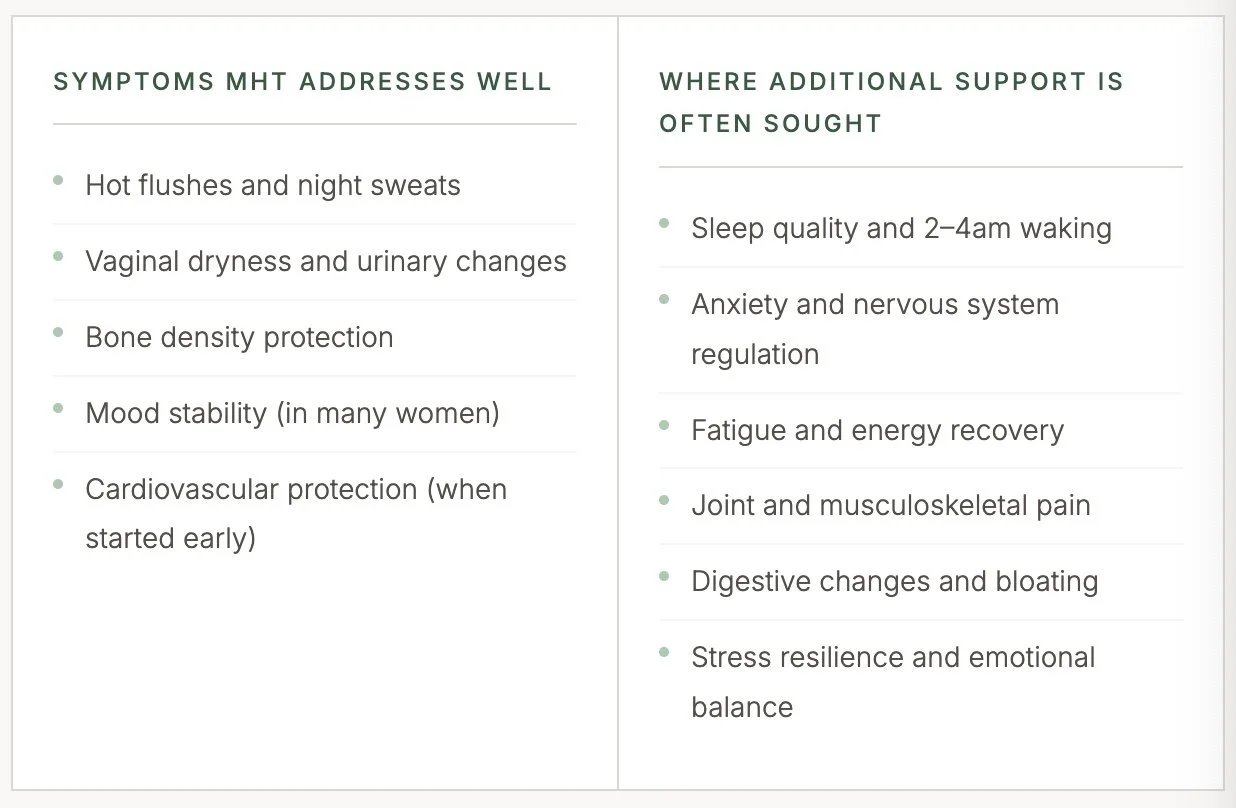
Menopausal hormone therapy (MHT, previously called HRT) remains the most effective treatment for vasomotor symptoms such as hot flushes and night sweats, and is the recommended first-line approach for most women experiencing significant menopausal symptoms, according to the International Menopause Society and the Australasian Menopause Society. It also plays an important role in bone protection, cardiovascular health, and genitourinary symptoms when initiated at the appropriate time.
MHT works by replacing the oestrogen (and in most cases progesterone) that the body is no longer producing in sufficient amounts. For many women, it provides substantial relief, and modern formulations, particularly transdermal oestrogen with micronised progesterone, carry a more favourable risk profile than older preparations.
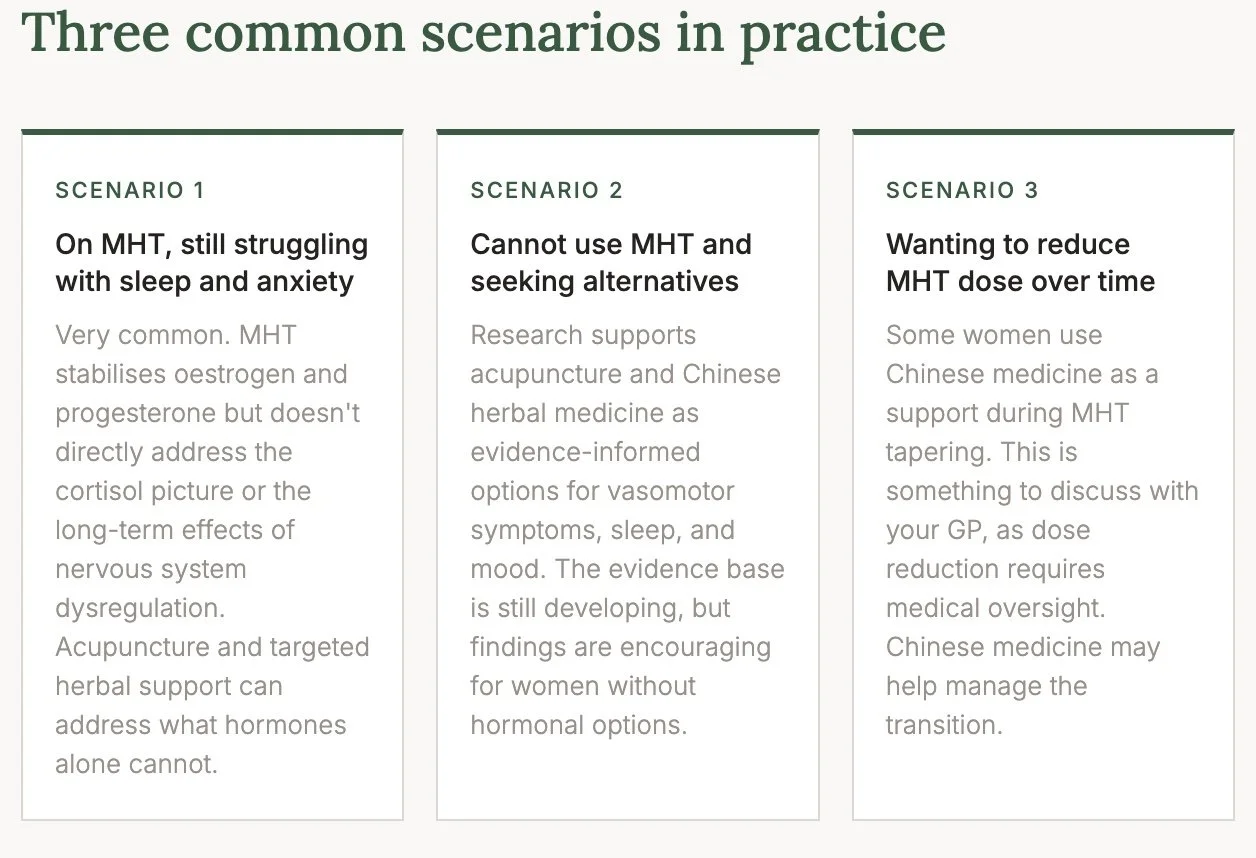
Not all women are suitable candidates for MHT. Some have contraindications including a personal history of certain hormone-sensitive cancers, blood clots, or cardiovascular disease. Others prefer non-hormonal approaches. And many women on MHT find that it does not fully resolve their symptom picture, particularly sleep, mood, energy, and musculoskeletal symptoms.
Where the gaps often remain
Even women who respond well to MHT frequently report that some symptoms persist or are only partially addressed. This is where the integrative picture becomes most useful. Common areas where women on MHT still benefit from additional support include:
Chinese medicine, including both acupuncture and herbal medicine, addresses the body from a whole-system perspective. Rather than targeting a single hormone pathway, it works to regulate the nervous system, support adrenal function, nourish underlying deficiencies, and resolve accumulated patterns of stagnation. These are not the same mechanisms as MHT, which is precisely why the two can complement each other effectively.
What does the research say about combining approaches?
A 2025 systematic review commissioned to inform the International Menopause Society's updated recommendations examined complementary therapies for menopause across 158 studies. It found promising evidence for acupuncture, Chinese herbal medicine, and mind-body therapies across a range of menopausal symptoms, while noting that most evidence was of low to moderate certainty. Importantly, the review found no evidence of harm from combining these approaches with conventional care for most women.
A 2024 meta-analysis of 42 studies involving 3,112 breast cancer patients (a group who frequently cannot use MHT) found that Chinese herbal formulas including Erxian Decoction and Danggui Buxue Tang were associated with significant reductions in hot flash scores and improvements in sleep and anxiety, and were noted as not interfering with endocrine therapy.
“For women who use MHT and Chinese medicine together, the question is rarely either/or. It is about understanding what each contributes and where the combination adds up to more than the sum of its parts.”
Important considerations about herbal medicine and MHT
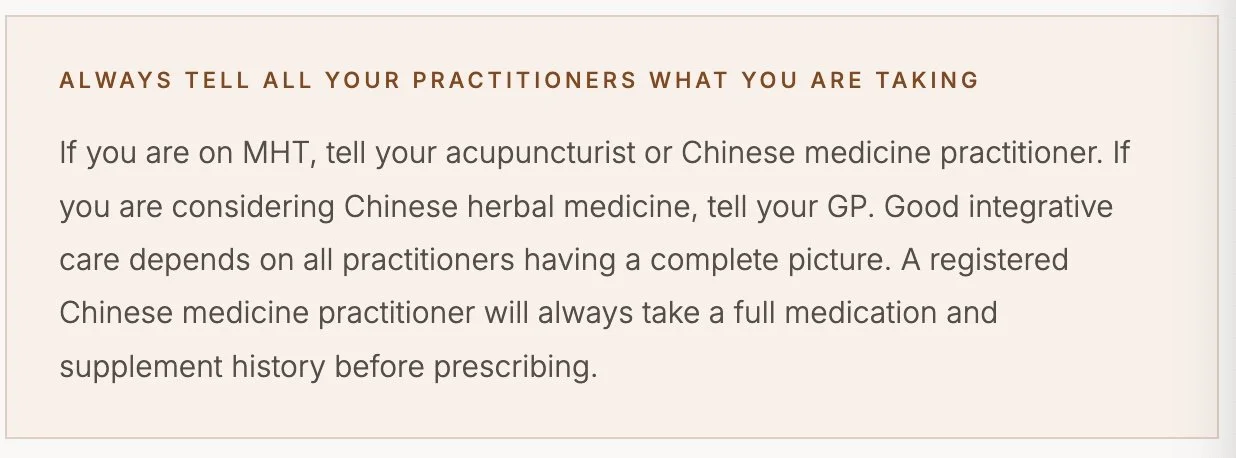
One area that warrants careful attention is the interaction between Chinese herbal medicines and MHT or other medications. Some herbs may influence hormone pathways, liver metabolism, or clotting. This is why it is essential that any herbal prescribing is done by an AHPRA-registered Chinese medicine practitioner who takes a full medication history and can identify potential interactions.
This is not a reason to avoid herbal medicine. It is a reason to ensure it is prescribed by someone qualified. Acupuncture carries no such interaction concerns and is safe to combine with MHT.
The integrative approach in practice
In my clinic, I regularly work alongside women who are on MHT prescribed by their GP. Chinese medicine in this context focuses on the parts of the clinical picture that hormones alone do not address: nervous system regulation, sleep architecture, digestive health, musculoskeletal discomfort, and energy. I always work with your GP's management plan, not against it.
For women who cannot use MHT, or who prefer not to, Chinese medicine is not a substitute for medical assessment, but it is a genuinely evidence-informed option for managing the symptom experience of menopause, supported by a growing body of clinical research.
Questions about how Chinese medicine fits your situation?
A consultation allows us to review your current medications, health history and symptom picture to discuss what a complementary approach might look like for you specifically.