When oestrogen declines & how this affects the brain
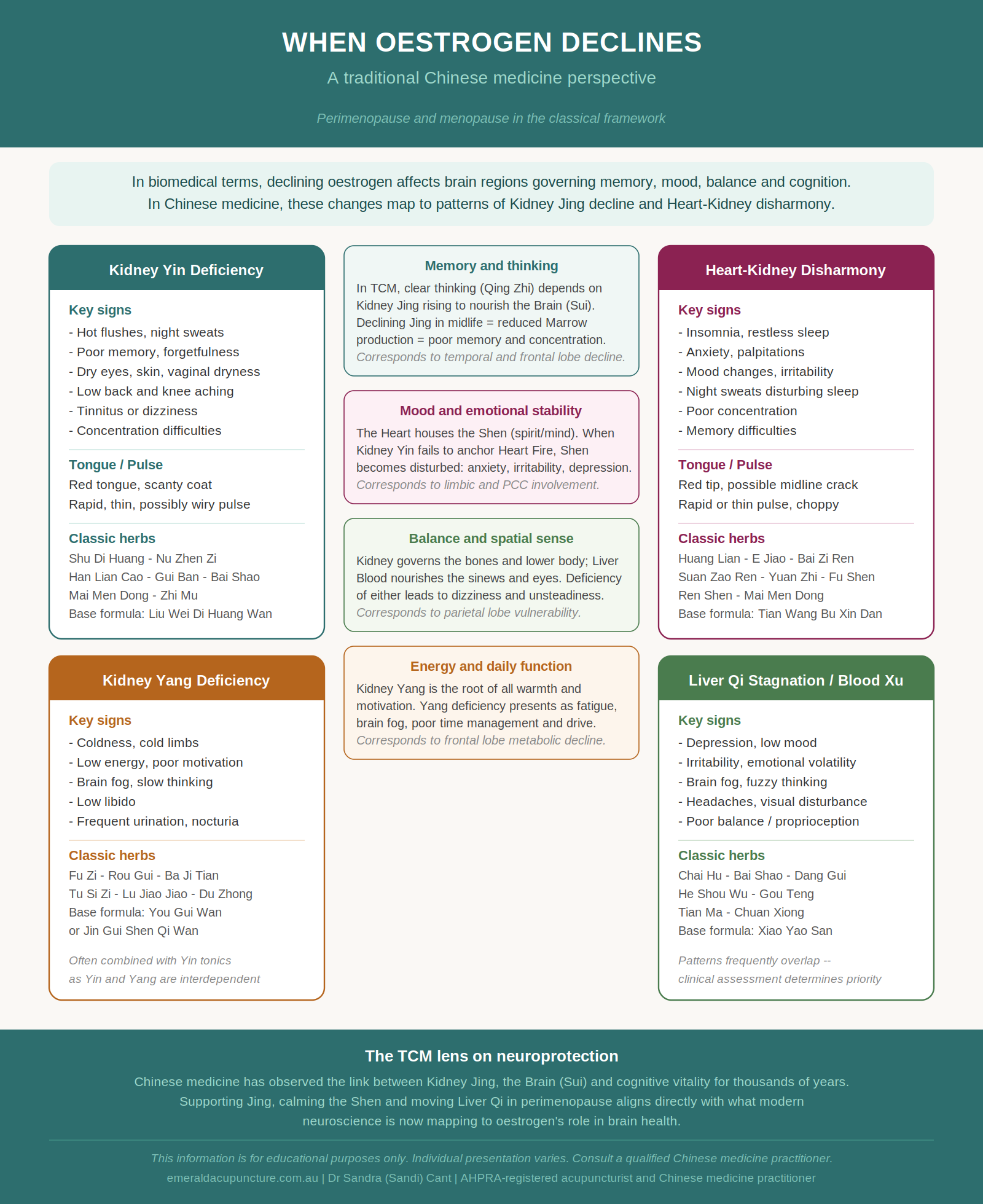
What happens to your brain in perimenopause - and what Chinese medicine says about it.
You're mid-sentence and the word vanishes. You walk into a room and have no idea why. You lie awake at 2am, mind racing, and drag yourself through the next day in a fog. You snap at someone you love and wonder who you're becoming.
If this sounds familiar, you're not imagining it, and you're not losing your mind. What you're experiencing is one of the least talked-about aspects of perimenopause: the effect of declining oestrogen on the brain.
Why oestrogen matters for your brain
Oestrogen is not just a reproductive hormone. It plays an active role in supporting blood flow, glucose metabolism and neural connectivity across key brain regions, including the areas responsible for memory, language, emotional regulation, spatial awareness and executive function.
As oestrogen levels begin to fluctuate and decline in perimenopause, these regions become more vulnerable. Research shows measurable changes in brain tissue in areas like the frontal lobe (decision-making and personality), temporal gyri (memory and language), parietal lobe (balance and spatial sense) and the posterior cingulate cortex, one of the earliest regions to show metabolic decline in Alzheimer's disease.
This is why brain symptoms in perimenopause are not a sign of weakness or stress. They are a physiological reality, rooted in hormonal change.
What Chinese medicine has understood for centuries.
Here is what I find so compelling about practising Chinese medicine in the context of women's midlife health: our medicine mapped these very changes thousands of years ago, just using different language.
In Chinese medicine, the brain is called the Sea of Marrow (Sui Hai), and it is nourished directly by Kidney Jing, the deep constitutional essence we are born with and gradually consume across our lifetime. A woman's Jing begins its natural decline around the age of 35 to 49, reflected in the classic Huangdi Neijing passage describing seven-year cycles of female physiology.
When Kidney Jing declines, Marrow production is reduced. The Brain is no longer as richly nourished. The result? Poor memory, difficulty concentrating, brain fog, dizziness, and a sense that cognitive sharpness has dulled.
But Jing decline does not happen in isolation. It typically triggers a cascade of patterns that Chinese medicine practitioners are trained to identify and distinguish.
Kidney Yin Deficiency is one of the most common presentations. The cooling, moistening, anchoring aspect of Kidney energy becomes depleted, producing hot flushes, night sweats, dry skin and eyes, low back aching, tinnitus and poor memory. The classic base formula here is Liu Wei Di Huang Wan, often modified with additional herbs to suit the individual.
Heart-Kidney Disharmony occurs when declining Kidney Yin can no longer anchor the Heart's Fire, which rises upward and disturbs the Shen, the spirit or mind that the Heart houses. This is the pattern behind the insomnia, anxiety, palpitations, emotional volatility and restlessness that so many perimenopausal women experience. Tian Wang Bu Xin Dan is a classical formula that speaks directly to this pattern.
Liver Qi Stagnation and Blood Deficiency often develop alongside Kidney decline. The Liver governs the smooth flow of emotion and nourishes the eyes, sinews and sense of balance. When Liver Blood is thin, thinking becomes foggy, moods become unpredictable, headaches emerge, and proprioception (the body's sense of where it is in space) can falter. Xiao Yao San is the foundational formula, frequently modified.
Kidney Yang Deficiency produces a different picture: deep coldness, exhaustion, low motivation, slow thinking and a heavy, leaden brain fog rather than the restless, heated quality seen in Yin deficiency. You Gui Wan or Jin Gui Shen Qi Wan are the classical approaches, often combined with Yin tonics since Yang and Yin are always interdependent.
These patterns are not diagnoses. They are conversations.
One of the things I want to gently push back on is the idea that perimenopause is a single, uniform experience that follows a predictable script. It is not. Two women of the same age, with the same hormone levels on a blood test, can present with completely different patterns and respond to completely different approaches.
That is where Chinese medicine excels. Rather than treating perimenopause as a hormone deficiency to be replaced, it asks: what is the specific texture of your particular experience? Where are you running hot and where are you running cold? What is disturbing your sleep? Is it heat, or anxiety, or pain, or all three?
The infographic at the top of this post maps the four most common TCM patterns seen in perimenopausal women alongside the brain regions and cognitive symptoms they correspond to in the biomedical framework. It is not prescriptive. It is a starting point for understanding that what you are experiencing has a name, has a framework, and has a path through it.
What this means in practice
Chinese medicine does not offer a single fix for perimenopause. What it offers is a thorough, individualised assessment of your pattern, followed by a treatment approach that may include acupuncture, herbal medicine, lifestyle recommendations and nutritional guidance, adjusted as your presentation evolves through the transition.
If you are experiencing brain fog, poor sleep, mood changes or memory concerns in perimenopause, I would encourage you to seek a proper pattern assessment rather than self-prescribing from this post. The formulas mentioned above are illustrative, not prescriptive. The right formula depends entirely on your individual presentation.
Your brain is not broken. It is navigating a significant hormonal transition. And there is a lot we can do to support it.
““Oestrogen and Kidney Jing are not the same thing. But they are asking the same question: how well are we nourishing the brain at midlife?””
Questions about how Chinese medicine fits your situation?
A consultation allows us to review your current medications, health history and symptom picture to discuss what a complementary approach might look like for you specifically.