BBT charting: what it is, how to do it, and what it tells you
If you’re seeing a Chinese medicine practitioner for fertility support, you may have been asked to chart your basal body temperature (BBT). Here’s what it is, how to do it, and why it’s worth the effort.
What is BBT?
Your basal body temperature is your lowest resting temperature. You take it first thing in the morning, before you get out of bed, talk or do anything else.
It helps with fertility because your hormones change your temperature across the cycle:
Before ovulation, oestrogen keeps your temperature lower.
After ovulation, progesterone raises it, and it stays up until your period.
If you chart every morning, you’ll start to see two phases: lower temperatures in the first half of the cycle, then a rise around ovulation that stays up until your period. This pattern is one of the most reliable signs that you’ve ovulated.
What thermometer do I need?
You need a digital basal thermometer. They’re sold at most pharmacies and online, usually for $15 to $30.
A standard household or fever thermometer won’t work. It only reads to one decimal place (for example 36.5°C), and the shifts you’re tracking are too small for it to pick up. A basal thermometer reads to two decimal places (for example 36.47°C).
Useful extras include:
a memory function, so you can take the reading half asleep and write it down later
a backlit screen for dark mornings
a beep when the reading is done
How to do it
The most important thing is consistency.
Keep the thermometer on your bedside table.
Take your temperature at the same time each morning, within 30 minutes of your usual wake time.
Take it by mouth, under your tongue, before you sit up, drink or talk.
Write the reading down straight away, on a paper chart or in an app such as Fertility Friend (the basic version is free).
Note anything that might affect the reading, such as illness, a late night, alcohol, travel or stress. Don’t leave the day blank. That information is useful too.
What a healthy chart looks like
First half (before ovulation): about 36.0 to 36.4°C
After ovulation: a rise of at least 0.3°C, to about 36.5 to 36.8°C
Second half: the higher temperature holds for 12 to 14 days, then drops a day or two before your period
If your temperature stays high and your period doesn’t arrive, you may be pregnant. This isn’t a pregnancy test, though, so confirm it with a proper test.
Many women can see the two phases in their first cycle. A clear pattern usually takes two to three full cycles to show.
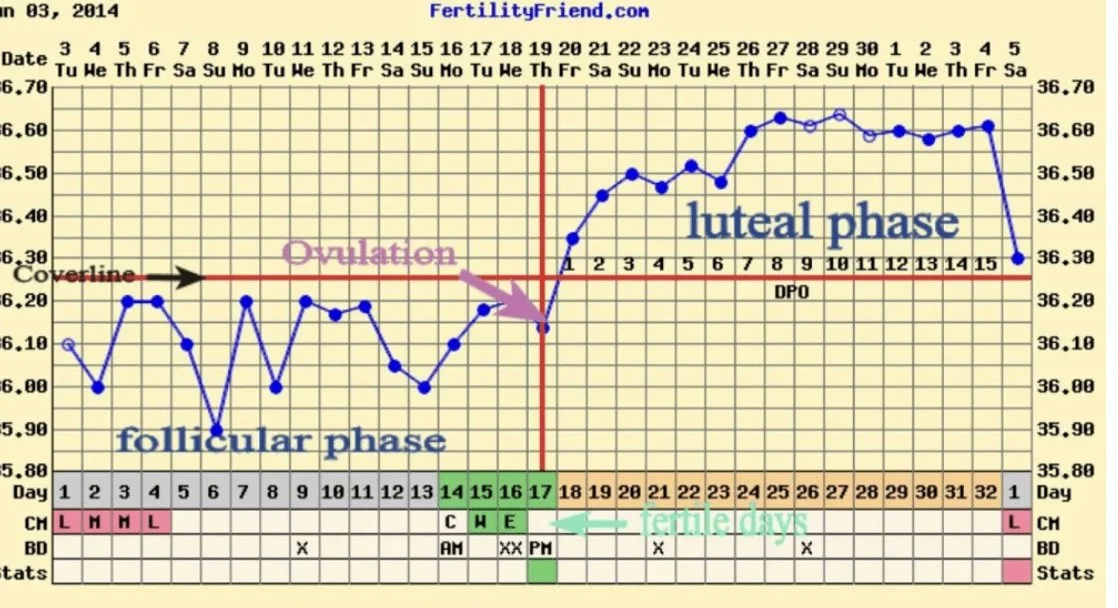
What BBT charting tells you that other tools do not
This is where the real value lies. Having a period does not tell you whether you ovulated. Many women have regular bleeds without releasing an egg, a pattern called an anovulatory cycle. BBT charting is one of the few affordable, accessible tools that can reveal this. Over several cycles it can show whether ovulation is occurring consistently, whether it is happening at a similar point each cycle, how long the second half of your cycle is, and whether the temperature rise after ovulation is strong enough to suggest adequate progesterone support.
A luteal phase shorter than 10 to 12 days, or a temperature that rises but drops away quickly before the expected end of the cycle, can be an indicator of low progesterone. This is worth knowing, both for the conversation you have with your GP and for guiding a Chinese medicine treatment approach.
One important limitation to understand
BBT confirms that ovulation has already happened. It does not predict when it is about to occur. The temperature rise happens after the egg has been released, not before. This means that for timing intercourse to maximise your chances of conception, BBT charting works best alongside cervical mucus observation. Fertile mucus, which tends to become clear, slippery, and stretchy in the days leading up to ovulation, gives you the advance warning that BBT alone cannot. Using both together gives you a much clearer picture of your fertile window.
Why charting matters even if you are doing IVF
Many women assume that once they enter an IVF program, natural cycle tracking becomes irrelevant. Several cycles of BBT data before a treatment cycle can still give your practitioner valuable information about the quality of your hormonal environment, particularly the function of the second half of your cycle. This can inform how Chinese medicine treatment is structured in the weeks before retrieval or transfer, with the aim of creating the best possible foundation before the cycle begins rather than simply supporting it once it is already underway.
Getting started
The investment is small. A basal thermometer costs around ten to fifteen dollars and Fertility Friend is free at its basic level. Start on the first day of your next period and record each morning. You do not need a perfect chart to bring to a consultation. Even a few cycles of data, including the disrupted readings and the irregular ones, tells a practitioner something useful. An imperfect chart is often more revealing than you might expect.
If you are already working with me and have not yet started charting, this is a good time to begin. If you have charts from previous cycles, bring them. They are one of the most clinically useful tools available and the information in them belongs to you.
This information is general in nature and is not intended as personalised medical advice. Please consult a qualified health professional with any specific concerns.